Generic selectors
Exact matches only
Search in title
Search in content
Post Type Selectors

Cloud Computing Fundamentals

Wishlist Share

About Course

Course Overview

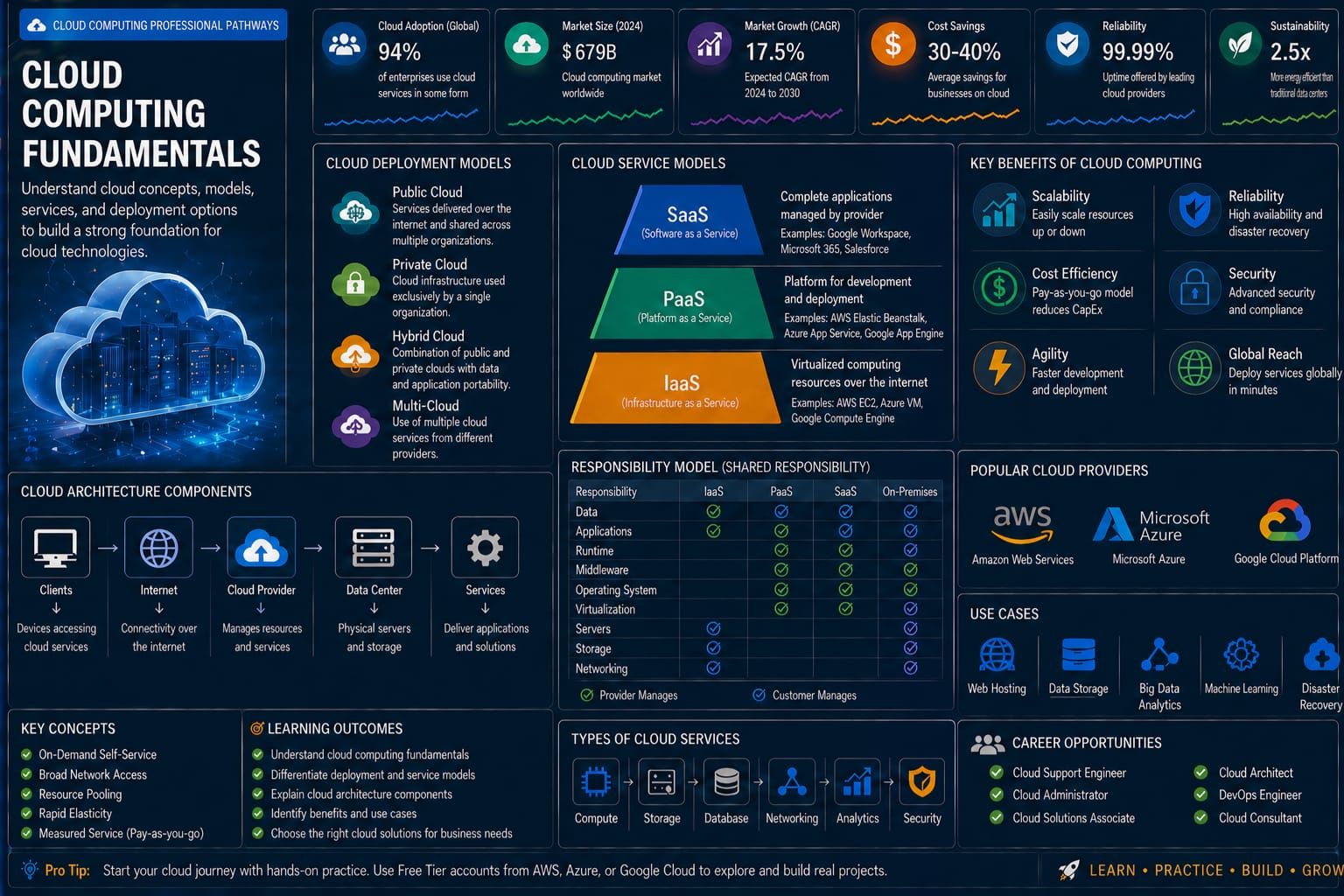
Cloud computing is the delivery of computing services over the internet, allowing users to access technology resources such as storage, databases, and processing power without owning or maintaining physical data centers and servers. Instead of investing in infrastructure, users can “rent” these resources from providers like Amazon Web Services (AWS), Microsoft Azure, and Google Cloud Platform (GCP).

It can be understood through a simple utility analogy: just as individuals do not build their own power plants but instead use electricity from a central grid and pay only for what they consume, cloud computing enables users to access computing power on demand and pay based on usage.

According to the National Institute of Standards and Technology (NIST), cloud computing is defined as on-demand access to shared, configurable computing resources (such as networks, servers, and storage) that can be rapidly provisioned with minimal management effort. This standardised definition highlights the efficiency, scalability, and flexibility that cloud computing offers to modern organisations.

Course Outcomes

By the end of this course, learners will be able to:

  • Understand cloud computing fundamentals
  • Identify deployment models and service models
  • Compare multi-cloud and poly-cloud strategies
  • Understand cloud characteristics like scalability
  • Apply cloud concepts in real-world scenarios

Target Audience

  • Beginners in cloud computing
  • IT professionals and developers
  • Students preparing for cloud careers
  • Business professionals exploring cloud technologies

Level

Beginner, No prior experience required

Pre-requisites

  • Basic computer knowledge
  • Understanding of internet basics
  • Interest in learning modern technology and cloud systems

What you should be able to do after completing the course

Learners will be able to:

  • Understand how cloud computing works
  • Choose appropriate cloud models
  • Apply cloud concepts in business and IT
  • Move to advanced cloud certifications
Show More

Course Content

DataCenter Vs Cloud
Datacenter vs Cloud refers to two different ways of managing IT infrastructure. A traditional datacenter uses physical servers, storage, and networking equipment owned and maintained by an organisation in a specific location. In contrast, cloud computing provides these resources over the internet through providers such as Amazon Web Services, Microsoft Azure, and Google Cloud. While datacenters offer full control, cloud solutions provide flexibility, scalability, and cost efficiency.

  • Lesson 1.1: What is Datacenter Model
  • Lesson 1.2: Challenges of Traditional Datacenter Vs Cloud
  • Lesson 1.3: Solution – Cloud
  • Module Quiz

Introduction to Cloud Computing
Cloud computing is the delivery of computing services such as storage, processing, and software over the internet, allowing users to access resources on demand without managing physical infrastructure.

Deployment Modules
Cloud computing is generally categorized into four main deployment models. Each model represents a specific type of cloud environment based on who owns the infrastructure and who has access to it

Service Models
While cloud deployment models (such as Public, Private, Community, and Hybrid) describe where the cloud infrastructure is hosted and who has access to it, service models explain how much control and responsibility the user has compared to the cloud provider. In other words, service models define how the workload is divided between managing infrastructure, platforms, and applications. This concept can be easily understood using the “Pizza as a Service” analogy. If you prepare a pizza entirely at home, you manage everything—from ingredients to cooking. If you order a ready-made pizza, you only consume it while someone else handles the preparation. Similarly, in cloud computing, the level of control shifts from the user to the provider depending on the service model chosen.

Knowledge Check

Earn a certificate

Add this certificate to your resume to demonstrate your skills & increase your chances of getting noticed.

selected template

Student Ratings & Reviews

No Review Yet
No Review Yet

Want to receive push notifications for all major on-site activities?